Two new papers reveal how children’s knowledge of time develops
April 16, 2026
How children remember time changes as they grow up—and understanding that shift matters more than we might expect.
Two new papers from the Preston Lab, led by recent PhD graduate Owen Friend, examine how temporal memory develops across childhood and adolescence, and what those changes reveal about the developing brain.
In a research article published in the Journal of Cognition and Development, we asked participants aged 7 to 25 to describe a typical day in their own words. Clear developmental differences emerged in how people organized time. Younger children tended to describe events sequentially, relying on cues like “then” and “before.” Older children and adults, in contrast, organized their experiences around routines, schedules, and recurring temporal structure.
Importantly, these changes were not explained by age alone. Children who had greater independence in managing their daily activities also showed more advanced temporal organization in their narratives, suggesting that lived experience plays a key role in shaping how time is represented in memory.
These findings highlighted a broader gap in the field. While prior work has documented both behavioral and neural changes in temporal memory across development, there has been no unified account of how detailed, event-specific memories and broader temporal structure emerge together.
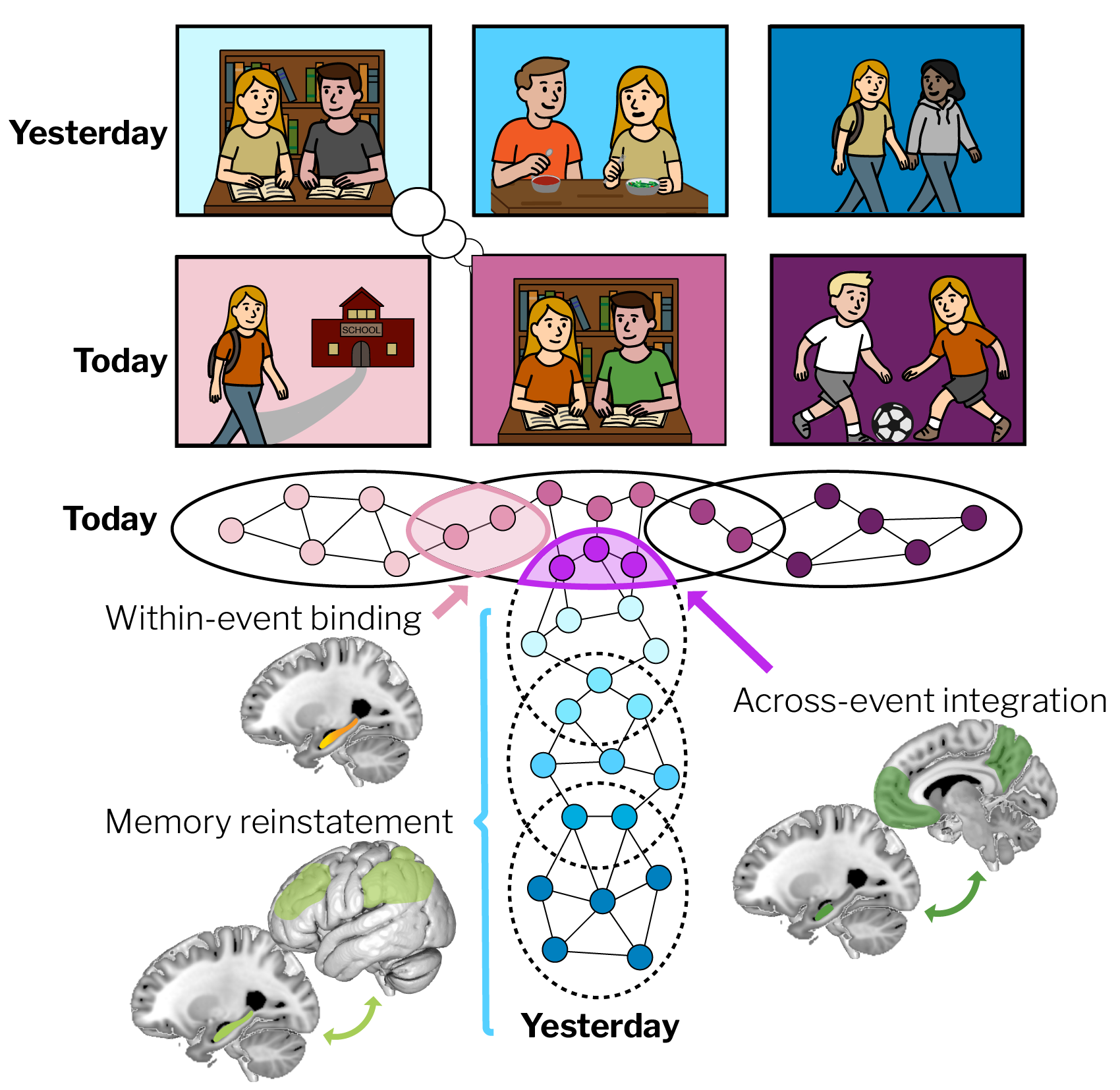
To address this gap, we developed a new theoretical framework, published in Developmental Cognitive Neuroscience with Jeni Pathman. Drawing on evidence from behavioral studies and neuroimaging, the framework proposes three stages of temporal memory development grounded in the maturation of the hippocampus and its interactions with frontoparietal cortex.
Early in development, memory is dominated by local, event-specific representations. Across childhood and adolescence, broader temporal patterns begin to emerge as hippocampal circuits mature. By adulthood, memory supports flexible access to both specific details and generalized temporal structure, depending on the demands of the situation.
Together, these papers highlight that children are not simply less accurate versions of adults. Their memory systems are organized differently. When children struggle to report precisely when something occurred, this struggle reflects the current state of their neural development rather than a failure of effort or credibility.
This distinction is particularly important in real-world contexts such as legal settings, where children are often asked to provide precise temporal details. Understanding how temporal memory develops can help ensure that children’s reports are interpreted appropriately and evaluated on their own developmental terms.