Stress prevents our ability to infer new knowledge
May 22, 2026
How does stress affect the mental links that let us draw new conclusions?
Our memories aren't isolated. We constantly connect separate experiences that share common elements, building structures that let us infer things we were never directly taught. If you see your friend's scooter parked outside the library, you might conclude they're studying inside.
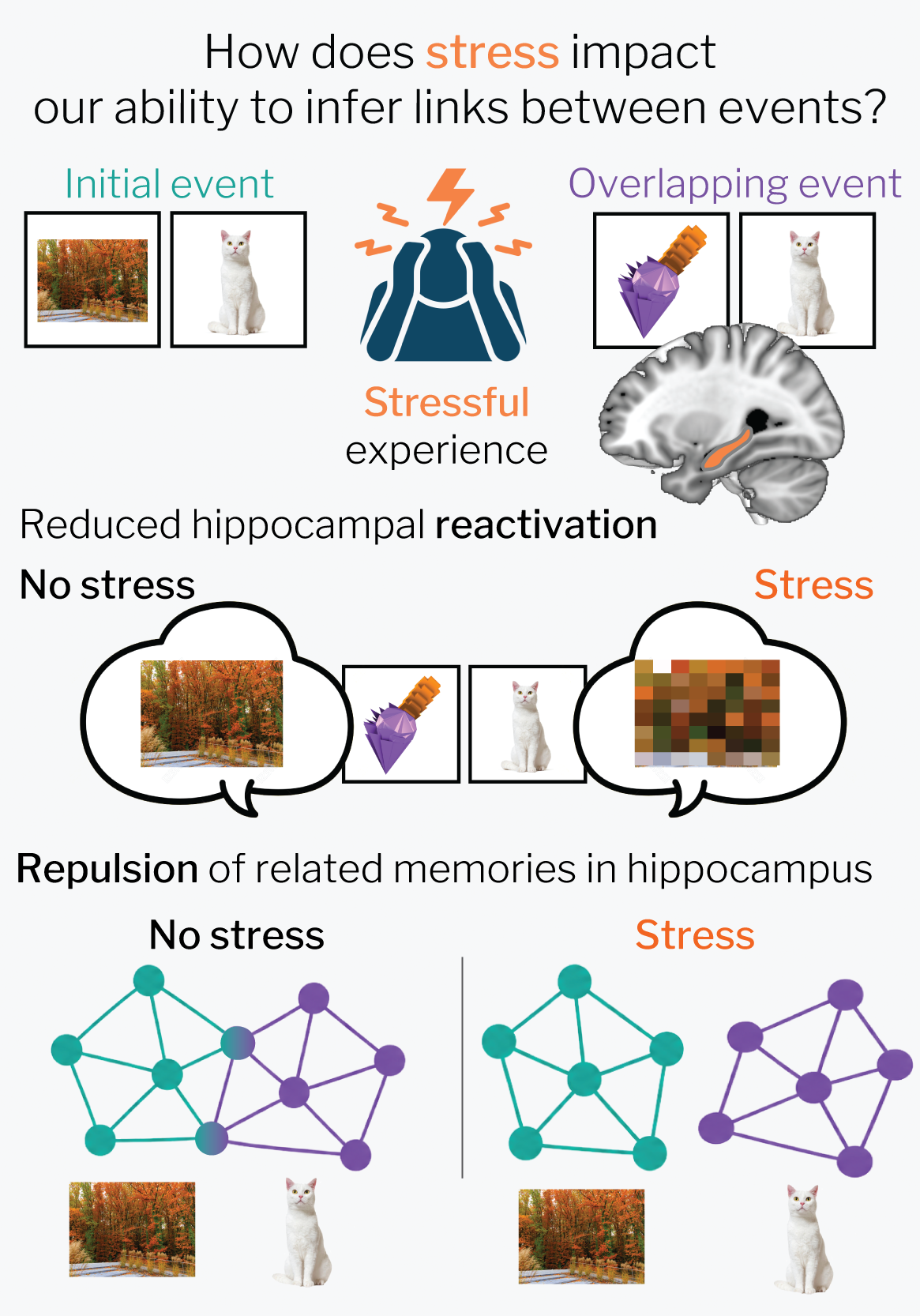
In our new paper in Science Advances, we tested what happens to this linking process under acute stress. Participants learned A–B associations on one day. The next day, half went through a psychosocial stressor before learning overlapping B–C associations. We then tested whether they could infer the indirect A–C relationship.
Stress didn't disrupt memory for the directly experienced pairs. Participants in both groups remembered their A–B and B–C associations equally well. But participants who experienced stress before encoding the overlapping pairs were worse at inferring A–C.
Two things happened in the hippocampus under stress. First, reduced reactivation of the prior, related memory during new learning, meaning stressed participants were less likely to reinstate the earlier event that would have linked the two experiences. Second, greater neural dissimilarity between overlapping events suggests that stress favored differentiation of related episodes rather than integration into a connected memory structure.
Overall, we find that stress may bias the brain toward preserving separate episodes rather than forming the connected knowledge that supports inference, generalization, and flexible use.
Grateful for the collaboration with Lars Schwabe's lab at Universität Hamburg, lead author Kai Schüren, and co-authors Nicole Varga, Hendrik Heinbockel, and Benno Roozendaal.