What changes in the brain when children begin to reason like adults?
April 22, 2026
What changes in the brain when children begin to reason like adults? Is development a matter of stronger memory, or a shift in how memory supports reasoning?
A new preprint led by Christine Coughlin addresses these questions using functional MRI and computational modeling. Children ages 7–12 and adults completed a memory-based inference task during scanning, and response-time modeling was used to identify the mechanisms supporting successful decisions.
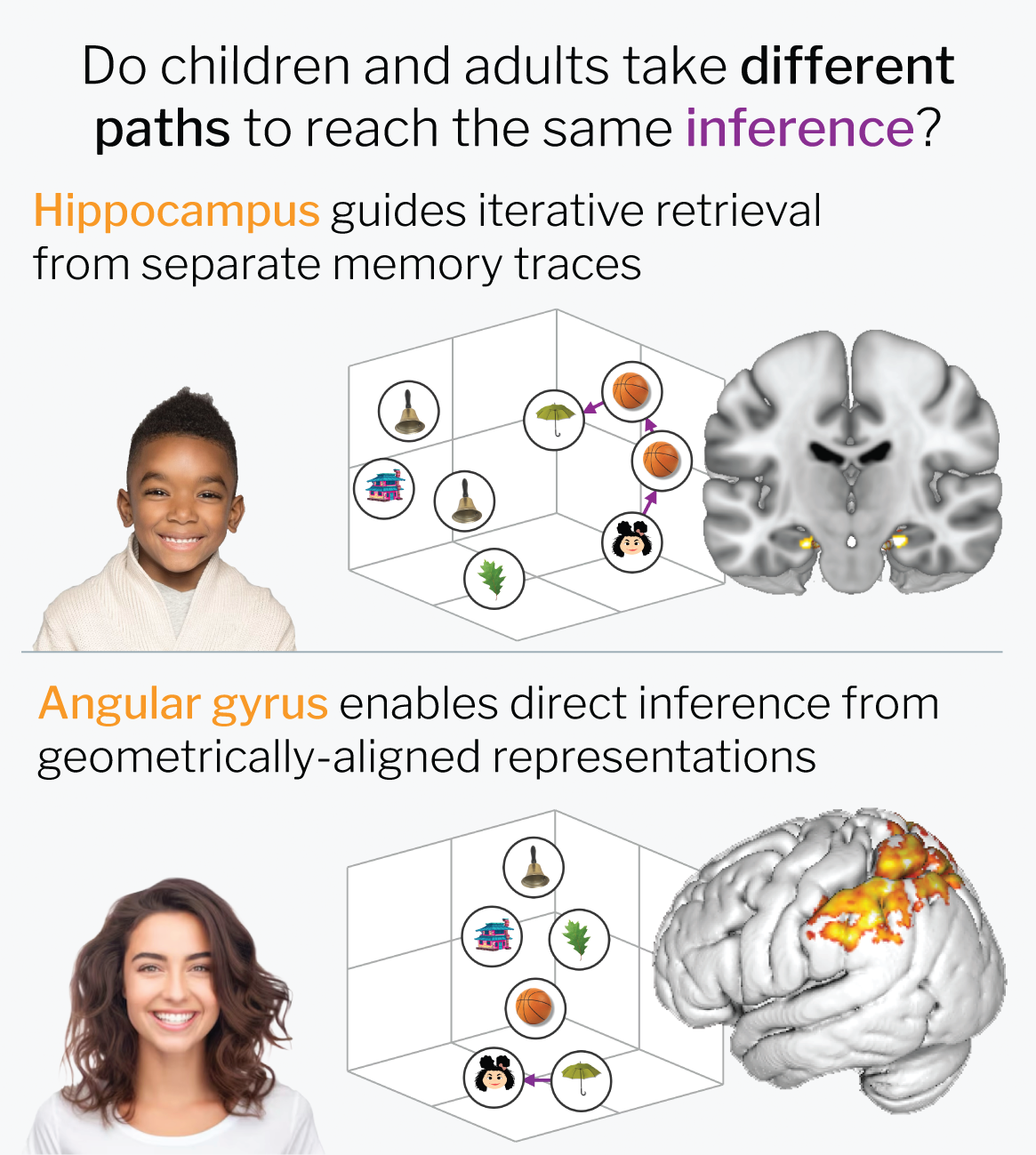
The findings show that both children and adults can reason successfully from memory, but they do not rely on the same computations. Across age groups, the hippocampus supported inference by linking separate memories at the time of decision. That process allowed participants to “stitch together” prior experiences to reach the correct answer.
Adults, however, also showed evidence for a different and more efficient route. Activity in angular gyrus was associated with a faster, more direct form of inference that appeared to rely on structured knowledge representations. Rather than reconstructing intermediate links from episodic details, adults could use the relational organization of memory to arrive at the answer more directly.
The work suggests that developmental change in reasoning is not simply a matter of forming stronger memories or faster retrieval. It reflects a broader reorganization in how knowledge is represented and used to guide decisions.
These findings have clear implications for education. Younger children may not spontaneously infer connections across learning experiences, even when they have the necessary knowledge. Prompting and scaffolding those inferences may be critical for building the structured knowledge that supports efficient reasoning. Learning, in this view, depends not just on exposure to information, but on actively shaping how that information is organized and connected.