How does the brain learn structure as events unfold in time?
March 11, 2026
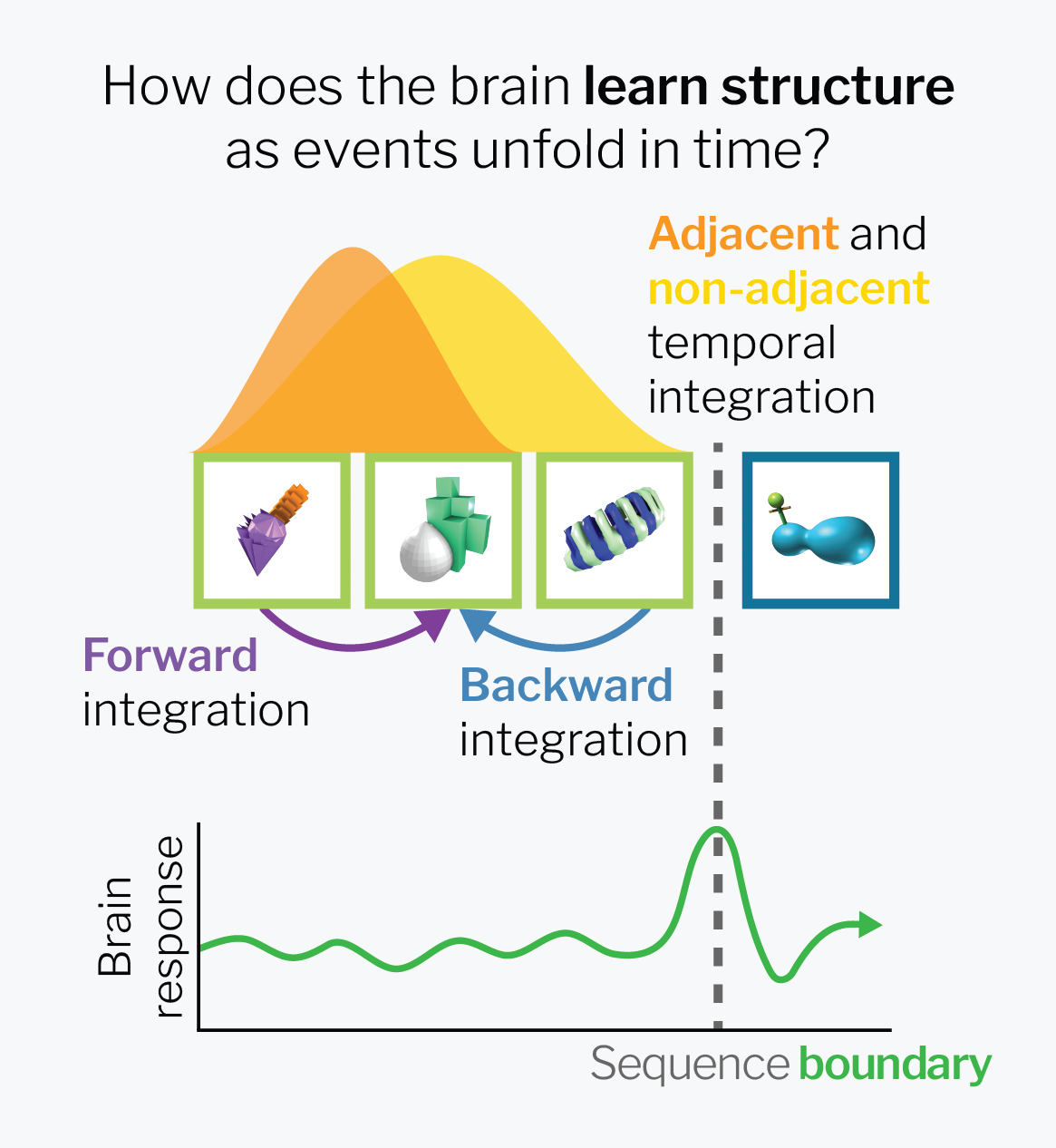
We only experience time moving forward. But memory allows us to both predict what will happen next and reconstruct what must have happened before.
In a new preprint led by graduate student Owen Friend, we show how development of the hippocampus enables this flexible representation of time.
We scanned children, adolescents, and adults while they learned predictable sequences of events. Critically, we measured neural representations before and after learning, allowing us to directly observe how memory representations changed.
Two key changes emerged across development:
First, the temporal scale of hippocampal representations expanded. Posterior hippocampus linked events that occurred right next to each other in time across all ages. However, anterior hippocampus increasingly linked events that were separated in time, integrating experiences across broader temporal windows.
Second, the direction of these representations changed. Children mainly linked events forward in time, as they were experienced (A → B). Adolescents and adults linked events in both directions (A → B and B → A), even though backward transitions were never observed.
Finally, the hippocampus did not work alone when learning these patterns. With age, frontoparietal regions coordinated with the hippocampus, tracking transitions between sequences and predicting how well participants later remembered their order.
Together, these results suggest that development transforms the neural representation of time itself.
As hippocampal representations change, the brain becomes able to predict further into the future and reconstruct further into the past by linking events across broader windows of experience.