Curious why kids and teens struggle to learn from their experience?
December 13, 2025
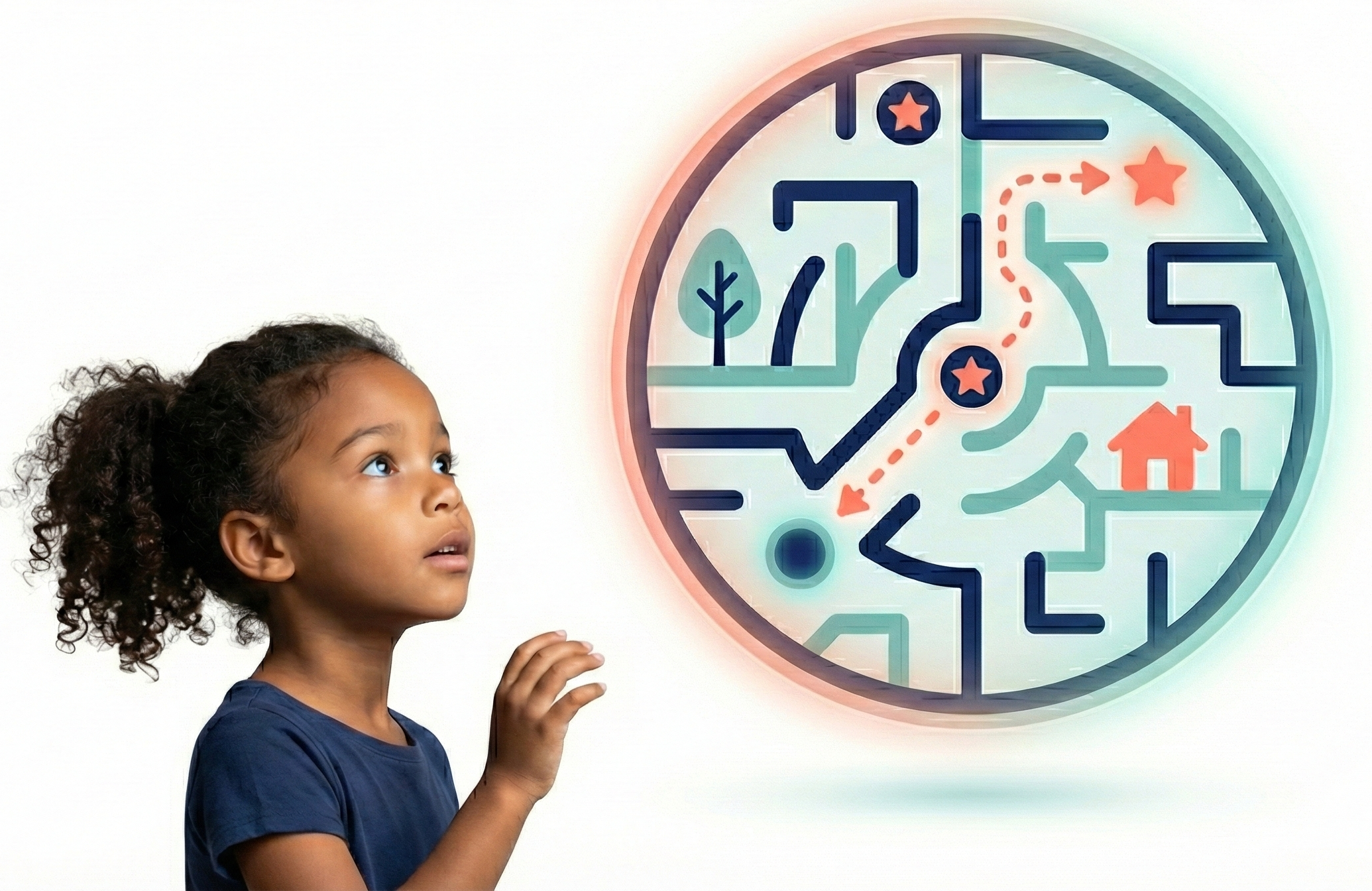
How do children learn to navigate a changing world, and why does this ability become more flexible with age? In a new preprint led by Nicole Varga and Owen Friend, we isolate how development of the anterior hippocampus supports this shift in memory ability from childhood to adulthood.
Children, teens, and adults either rested or played a virtual “hide-and-seek” game with friendly monsters during fMRI scanning. We found that representational drift (i.e., the consistency in signal across time) in anterior, but not posterior, hippocampus was slower in adults relative to both children and teens.
The slower representational drift in anterior hippocampus allowed adults to integrate information across broader windows of time and space during the hide-and-seek game, supporting the formation of a holistic map of the virtual environment. When the environment rotated or new monsters were introduced, adults were able to adapt their map to continue to navigate efficiently in the changed environment.
In contrast, children and teens were less able to adapt to the changing environment due to the immaturity of the anterior hippocampus. Each time the environment changed, they were unable to generalize from past experience and had to relearn a new map of the altered environment.
These findings show how brain development supports a shift from learning isolated, local memories to building flexible, generalizable knowledge. They also help explain why children and teens can struggle to apply what they've learned in one situation to a new one—their brain infrastructure is still maturing!
Read more about our new findings here.